

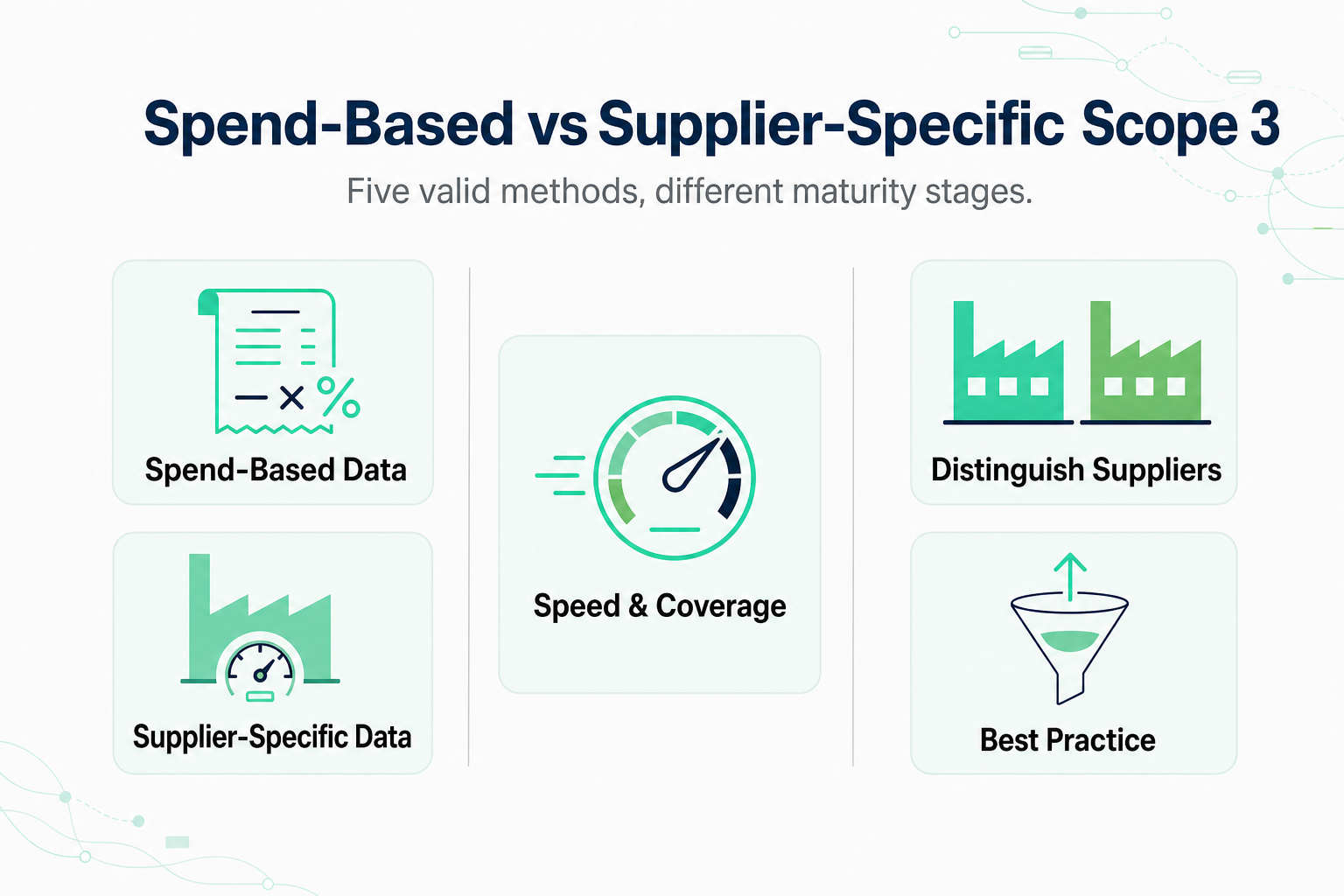
Spend-based data estimates supplier emissions by multiplying money spent on a purchase by an industry-average emission factor. Supplier-specific data uses primary, product-level activity data collected directly from the supplier. The GHG Protocol treats both as valid Scope 3 calculation methods and lists them in order of how specific each one is to the individual supplier, with supplier-specific first and spend-based last. It is careful to separate that ordering from accuracy. Neither method is wrong. They answer different questions, at different points in a company's Scope 3 maturity.
Summary
- Spend-based data multiplies what you paid by an industry-average factor. Supplier-specific data uses what the supplier actually measured.
- Specific is not the same as accurate: the GHG Protocol warns that supplier data can be less accurate than a good industry average.
- Spend-based cannot distinguish a low-carbon supplier from a high-carbon one in the same category, which is its real limit.
- Use spend-based data for initial screening, then prioritise better supplier data where greater specificity can improve the quality of the inventory or support a decision.
What Is Spend-Based Scope 3 Data?
Spend-based data estimates emissions from what a purchase cost, not from what was physically produced or moved. You multiply spend in a category by an emission factor expressed per unit of currency. Those factors come from environmentally extended input-output models built on national economic statistics, not from your supplier. EXIOBASE is the database most commonly used.
It is the practical starting point because it runs on financial records you already hold, across your whole supplier base, without contacting anyone.
The trade-off is that it tracks money. Negotiate a discount and your reported emissions fall although nothing physical changed. Two suppliers in the same category produce identical figures whether one runs on renewables and the other on coal. Spend-based tells you which categories are large. It cannot tell you which supplier to call.
What Is Supplier-Specific Scope 3 Data?
Supplier-specific data uses primary information from the supplier itself: metered energy, production volumes, transport distances, or a product-level carbon footprint. It reflects what that supplier actually did rather than what its sector does on average.
That specificity is what makes it useful for decisions. It can separate a low-carbon supplier from a high-carbon one inside the same spend category, which is exactly what spend-based data cannot do, and it responds when a supplier genuinely improves.
It is also harder to get, and being specific does not make it correct. A supplier figure carries assumptions about what was counted and how shared factory emissions were divided between products. Where those are undocumented, it is precise-looking rather than reliable.
More specific does not automatically mean more accurate. Supplier-specific data can provide a more detailed picture, but its usefulness still depends on the quality of the underlying data, methodology, boundaries and assumptions.
Spend-Based vs Supplier-Specific: Side-by-Side Comparison
| Factor | Spend-Based | Supplier-Specific |
|---|---|---|
| Data source | Financial/procurement records | Supplier activity data |
| GHG Protocol ordering by specificity | Least specific of the four methods | Most specific of the four methods |
| Speed to calculate | Fast, uses existing spend data | Slower, depends on supplier response |
| Can distinguish low- vs high-carbon suppliers | No, within the same spend category | Yes, when data quality is verified |
| Effect of price negotiation | Changes reported emissions figure | No effect; based on activity, not price |
| Best suited to | Initial full-portfolio screening | Material categories and target-setting |
Need support collecting and requesting supplier data?
Book a DemoDo Regulators Require One Method?
Broadly, no. Disclosure standards require you to report Scope 3 where it is material and to say how you calculated it; they do not mandate a method per category. The exception is border carbon pricing, where the liability turns on actual embedded emissions from the producer rather than an average. Jurisdiction-specific dates and duties are covered separately in the Singapore reporting requirements article.
For Singapore-specific requirements and timelines, see Scope 3 Reporting Requirements in Singapore.
How Should a Company Choose Between the Two?
The choice depends on what the data needs to do. Spend-based data can provide broad visibility across a large supplier base using information the company already holds. Supplier-specific data becomes more useful where greater specificity can improve the inventory or support decisions involving material categories, suppliers or products.
In practice, companies do not need to choose one method for the entire inventory. They can use spend-based estimates for initial screening and lower-priority areas, while progressively improving the data for material areas where better supplier information is useful.
For guidance on selecting emission factors, see How to Calculate Scope 3 Emissions: Methods and Data Explained.
Improve the data where it can improve the decision. Use estimates to establish broad visibility, then prioritise better supplier data for the categories, suppliers or products where greater specificity is useful.
For a broader explanation of all four Scope 3 calculation methods, see How to Calculate Scope 3 Emissions: Methods and Data Explained.
How to Start
Moving from estimates to better supplier data is a gradual process. Once you know where supplier-specific information would improve your inventory, the next step is building a repeatable way to collect that information from the suppliers that matter most.
Next: How to Collect Scope 3 Data From Suppliers ->
Gprnt helps enterprises structure supplier sustainability data so it can be collected once and reused, with permission, across relevant reporting, procurement and financing use cases. It complements existing calculation and reporting processes rather than replacing them.
Scope 3 Allocation Module
Moving from spend-based estimates to supplier data?
Gprnt is building a new module to help companies manage, allocate and track supply chain emissions data with greater ease and clarity. Register your interest and our team will share more details.
Register your interestFrequently Asked Questions
Can I mix both methods in one Scope 3 report?
Yes, and most companies do. Data availability differs by category and by supplier, so a single inventory normally combines both. Record which method was used where.
Why would supplier-specific data ever be less accurate?
Because accuracy depends on the records behind the number, not on who produced it. A supplier figure carries its own assumptions about what was counted and how shared emissions were split between products. If those are undocumented, it is precise-looking rather than reliable.
References
- GHG Protocol Corporate Value Chain (Scope 3) Accounting and Reporting Standard (2011)
- GHG Protocol, Technical Guidance for Calculating Scope 3 Emissions, Category 1: Purchased Goods and Services
- European Commission, Corporate Sustainability Reporting Directive: implementing and delegated acts
- European Commission, Q&A on the Voluntary Sustainability Reporting Standard for SMEs (VSME)
- European Commission, Carbon Border Adjustment Mechanism
- SBTi, Criteria and Recommendations for Near-Term Targets
- California Senate Bill 253, Climate Corporate Data Accountability Act (2023)
- ACRA and SGX RegCo, Extended Timelines for Most Climate Reporting Requirements (August 2025)