
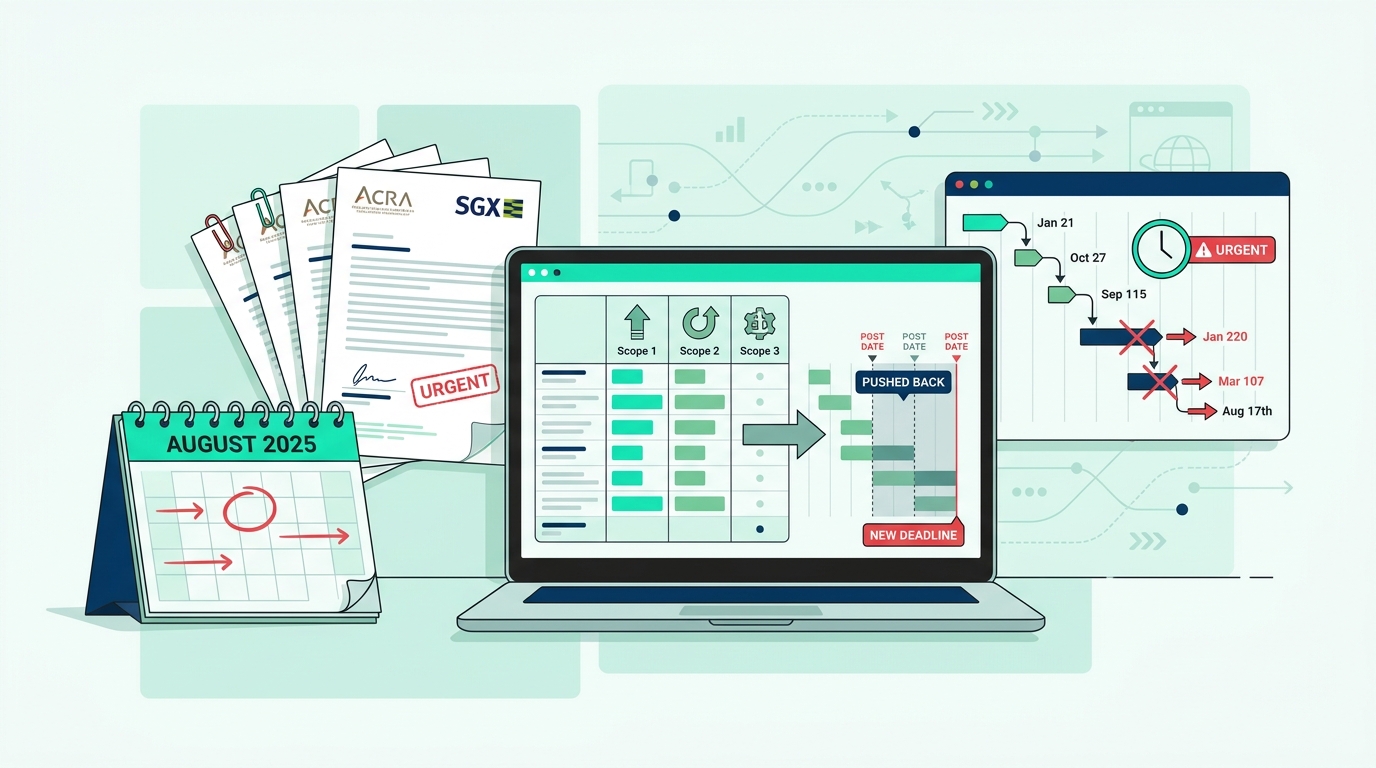
Most Singapore companies asking about Scope 3 want one thing first: does this apply to me, and by when. The answer changed in August 2025, when ACRA and SGX RegCo revised the climate reporting timetable and pushed several deadlines back. A lot of guidance still circulating online describes the old schedule.
Here is the position now in force, and what it means if a deadline is still years away.
Summary
- Scope 3 reporting is mandatory for STI constituents from FY2026; for other listed issuers and large non-listed companies, it remains voluntary until further notice under the revised Singapore timetable.
- External limited assurance over Scope 1 and 2 begins later, but companies should build traceability into their data collection processes well before assurance becomes mandatory.
- Companies that are not yet required to report may still receive emissions-data requests from customers and financial institutions.
- For many businesses, the commercial need for sustainability data may therefore arrive before the regulatory deadline.

Which Rules Apply in Singapore?
Singapore gives the ISSB standards local effect through SFRS(I) S1 and S2, and SGX RegCo applies them to listed issuers. So the obligation is ISSB-based rather than a separate national framework, and the measurement underneath it follows the GHG Protocol.
When Does Scope 3 Become Mandatory?
Scope 3 is mandatory for one group today. For everyone else it is voluntary until further notice, on the timetable ACRA and SGX RegCo revised in August 2025.
| Entity | Scope 1 and 2 | Scope 3 | Other ISSB disclosures |
|---|---|---|---|
| Straits Times Index (STI) constituents | FY2025 | FY2026 | FY2025 |
| Other listed issuers, market cap S$1bn and above | FY2025 | Voluntary until further notice | FY2028 |
| Other listed issuers, below S$1bn | FY2025 | Voluntary until further notice | FY2030 |
| Large non-listed companies | FY2030 | Voluntary until further notice | FY2030 |
A large non-listed company means revenue of at least S$1bn and total assets of at least S$500m. Market capitalisation for the listed thresholds was assessed at the close of market on 30 June 2025.
When Does the Data Need to Be Assured?
Assurance runs on its own clock, and it is the deadline companies most often miss in planning. External limited assurance over Scope 1 and 2 emissions applies from FY2029 for listed issuers and from FY2032 for large non-listed companies.
That matters earlier than the date suggests. Assurance tests the trail behind a number, not the number itself, so the records have to exist while the data is being collected. Reconstructing provenance two years later is the expensive way to do it.
Prepare for assurance when you collect the data, not when assurance becomes mandatory. Assurance depends on the trail behind the number. Build traceability and provenance into the data collection process from the start rather than trying to reconstruct it later..
Want to get a headstart in your Scope 3 reporting?
Book a DemoWhat If You Are Not Yet in Scope?
Most Singapore companies are not, and will still be asked for Scope 3 data well before their own deadline arrives. The request comes from customers and banks rather than from a regulator.
A Singapore supplier to a large multinational sits inside that customer's Scope 3 boundary. Whatever the supplier's own filing duty, the customer needs its emissions figure to complete their inventory.
The same applies to a bank assessing a green loan, where the borrower's emissions feed the bank's financed emissions.
This is why "we are not in scope until FY2030" is a weak planning assumption. The commercial deadline usually arrives before the regulatory one.
Your commercial deadline may arrive before your regulatory one. Even if your company is not yet required to report Scope 3, customers and financial institutions may ask for emissions data to meet their own reporting and financing requirements.
How Do Global Reporting Regulations Reach Singapore Companies?
Indirectly, through customers, not through a direct filing obligation. Two are worth knowing because they shape what your customers will ask you for.
- The EU's Corporate Sustainability Reporting Directive (CSRD) requires Scope 3 where material under ESRS E1. Its first wave reported for financial year 2024; later waves were postponed by two years and the scope narrowed.
- California SB 253, the Climate Corporate Data Accountability Act, requires Scope 3 disclosure from 2027 for companies doing business in California above its revenue threshold.
Australia and Japan have introduced their own climate disclosure regimes on similar lines, so the pattern is broader than these two.
There is a limit on what an EU customer may demand. Under the value chain cap, a company reporting under the CSRD may not require a smaller undertaking in its value chain to provide more than the voluntary standard for small and medium-sized enterprises (VSME) sets out. This applies only where that customer is itself in scope of CSRD reporting, so it is worth confirming before treating it as a ceiling.
What Should You Do Now?
Work backwards from whichever deadline reaches you first, which for most companies is a customer's rather than a regulator's.
- Find your row in the table above and note both dates: disclosure and assurance.
- Ask your three largest customers whether they report under CSRD, ISSB or a comparable regime. Their answer sets your real timeline.
- Get Scope 1 and 2 in order first. They are mandatory earlier for every listed issuer, and they are what customers ask suppliers for before anything else.
- Start assessing Scope 3 before it becomes mandatory. Identify the categories that matter most and establish a baseline while you still have time to improve the underlying data. .
For a practical starting point, see [What Are Scope 3 Emissions? A Practical Guide for Enterprises] and How to Calculate Scope 3 Emissions: Methods and Data Explained.
Frequently Asked Questions
Has the Singapore timetable changed?
Yes. ACRA and SGX RegCo revised it in August 2025, deferring several deadlines including ISSB-based disclosures for large non-listed companies to FY2030 and assurance to FY2029 and FY2032. Guidance published before that date will describe the earlier schedule.
Do unlisted Singapore SMEs have to report Scope 3?
Not under the current timetable. They are still commonly asked for emissions data by larger customers and banks who need it for their own reporting, which is a commercial requirement rather than a regulatory one.
How to Start
The dates above set the outer limit. What usually sets the real one is the first customer or bank that asks, and they rarely give two years of notice.
The practical difficulty is not knowing the deadline; it is producing the same structured data repeatedly for different requesters. Gprnt is the shared sustainability data infrastructure Singapore built for that: report once in a structured form, then let customers, banks and reporting programmes draw on it with permission. See how it applies to your business at gprnt.ai.
Scope 3 Allocation Module
Preparing for Singapore's Scope 3 timelines?
Gprnt is building a new module to help companies manage, allocate and track supply chain emissions data with greater ease and clarity. Register your interest and our team will share more details.
Register your interestReferences
- ACRA and SGX RegCo, Extended Timelines for Most Climate Reporting Requirements (August 2025)
- SGX, Sustainability Reporting
- European Commission, Corporate Sustainability Reporting Directive: implementing and delegated acts
- European Commission, Q&A on the Voluntary Sustainability Reporting Standard for SMEs (VSME)
- California Senate Bill 253, Climate Corporate Data Accountability Act (2023)