
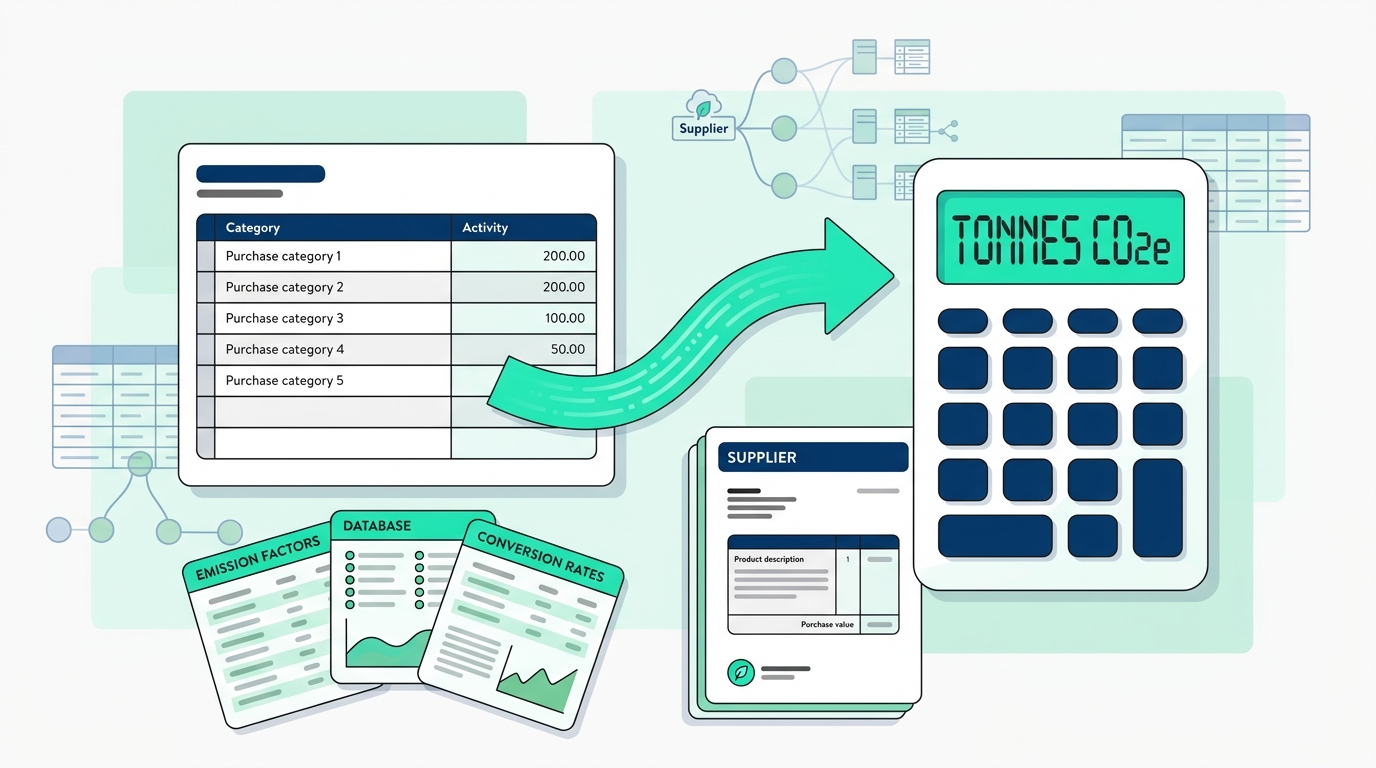
You have screened the 15 categories and you know which ones carry your footprint. The next question is mechanical: how do you turn what your business actually did into a number in tonnes?
Every Scope 3 calculation is the same shape. Take activity data, which is a record of something that happened, and multiply it by an emission factor, which converts that activity into carbon dioxide equivalent. What changes between methods is how specific the activity data is, and how close the emission factor sits to your actual supplier.

What Are the Four Calculation Methods?
There is no single data source or calculation method that works equally well across every Scope 3 category. For purchased goods and services, for example, GHG Protocol technical guidance describes supplier-specific, hybrid, average-data and spend-based approaches. In practice, companies often use a combination of methods because the best available data differs by category, activity, and counterparty.
| Method | What it uses | Where it can fit |
|---|---|---|
| Supplier-specific | Product-level cradle-to-gate emissions data from the supplier | Material suppliers or products where robust supplier data is available and useful |
| Hybrid | Supplier-specific information combined with secondary data for gaps | Situations where some primary data exists but is incomplete |
| Average-data | Physical activity data combined with industry-average emission factors | Categories with useful quantity/activity data but limited supplier-specific reporting |
| Spend-based | Procurement spend combined with environmentally extended input-output factors | Initial screening and estimation where more specific activity data is unavailable |
Spend-based data can be a practical starting point because it can be calculated using procurement data that many companies already hold, without first collecting information from suppliers.
Need support collecting and requesting supplier data?
Book a DemoWhy Spend-Based Data Distorts, and When That Matters
Spend-based factors come from environmentally extended input-output models built on national economic statistics, not from your supplier. EXIOBASE is the database most commonly used for this. It is a global multi-regional environmentally extended input-output database, which is what lets a figure in dollars be converted into a figure in tonnes.
The distortion is worth understanding before you rely on the output. Because the calculation tracks money rather than activity, negotiating a discount reduces your reported emissions even though nothing physical changed. Two suppliers in the same spend category produce identical figures whether one runs on renewables and the other on coal. Spend-based data can tell you which categories are large. It cannot tell you which supplier to talk to.
Is Supplier Data Always Better?
It is tempting to read these approaches as a ladder: poor estimates at the bottom, good supplier data at the top. It is not that simple.
Supplier-specific data is more specific to the supplier, but it is not automatically more accurate. Its usefulness depends on the quality of the underlying records, the boundary used, the methodology applied, and how shared emissions are allocated between products. In some circumstances, well-constructed industry-average data may therefore be more reliable than poor-quality supplier-specific data.
More specific does not automatically mean more accurate. The goal is not to maximise the percentage of supplier-specific data for its own sake. The goal is to improve the reliability and decision-usefulness of the inventory in the areas that matter.
The standard says the same thing directly. The GHG Protocol notes that supplier data "may actually be less accurate than industry-average data for a particular product", and that companies "need not always use the most specific method as a first preference".
A practical maturity journey therefore moves from broad visibility towards data that is sufficiently specific, reliable, and useful for the decision at hand. Spend-based estimates may be adequate for initial screening. Better physical activity data may improve a material category.
Supplier-specific information may be valuable for priority suppliers or products, but only when the underlying data and methodology are sound.
Where Should You Start?
Use the method that matches what the number has to do. Start with estimates to identify where emissions are concentrated, then improve the data for material categories where greater specificity will support better decisions.
- Use spend-based for initial screening. It runs on data you already hold and tells you where the footprint concentrates.
- Move to activity data for the categories screening shows are material. Physical quantities remove the price distortion.
- Collect supplier-specific data only where a better number would change a decision: a supplier you are about to re-tender, a product you are redesigning, a category you have set a target against.
- Use appropriate esstimates for the long tail where collecting primary data would add limited value. Chasing primary data for categories worth a fraction of a percent costs more than the precision is worth.
Which Emission Factors Should You Use?
Pick a factor set before you collect anything, and keep it consistent year on year. If the database changes between cycles, your trend line measures your database rather than your supply chain.
Widely used public sets include the UK government conversion factors and the US EPA Emission Factors Hub. ecoinvent and EXIOBASE are the common licensed options for life-cycle and input-output factors respectively.
What Do You Have to Disclose?
Whichever methods you use, record them. The GHG Protocol expects companies to state the calculation method applied per category, the assumptions behind it, and the share of each category calculated from primary supplier data rather than estimates. A mixed inventory is normal and expected. An undocumented one is the problem.
Frequently Asked Questions
Can I use different methods for different categories?
Yes, and most companies do. Data availability differs by category and by supplier, so a single inventory will normally combine supplier-specific, activity and spend-based figures. Document which was used where.
How accurate does a first Scope 3 inventory need to be?
Accurate enough to show where emissions concentrate and to support a prioritisation decision. Precision matters where a number drives a target, a procurement choice or a disclosure that will be assured. Elsewhere, a documented estimate is sufficient.
How to Start
Once you have identified where better data will make the biggest difference, the next challenge is obtaining that data consistently from suppliers.
Gprnt helps enterprises structure supplier sustainability data so it can be collected once and reused, with permission, across relevant reporting, procurement and financing use cases. It complements your existing calculation and reporting processes rather than replacing them.
Next: How to Collect Scope 3 Data from Suppliers ->
Scope 3 Allocation Module
Allocating emissions across categories and suppliers?
Gprnt is building a new module to help companies manage, allocate and track supply chain emissions data with greater ease and clarity. Register your interest and our team will share more details.
Register your interest