

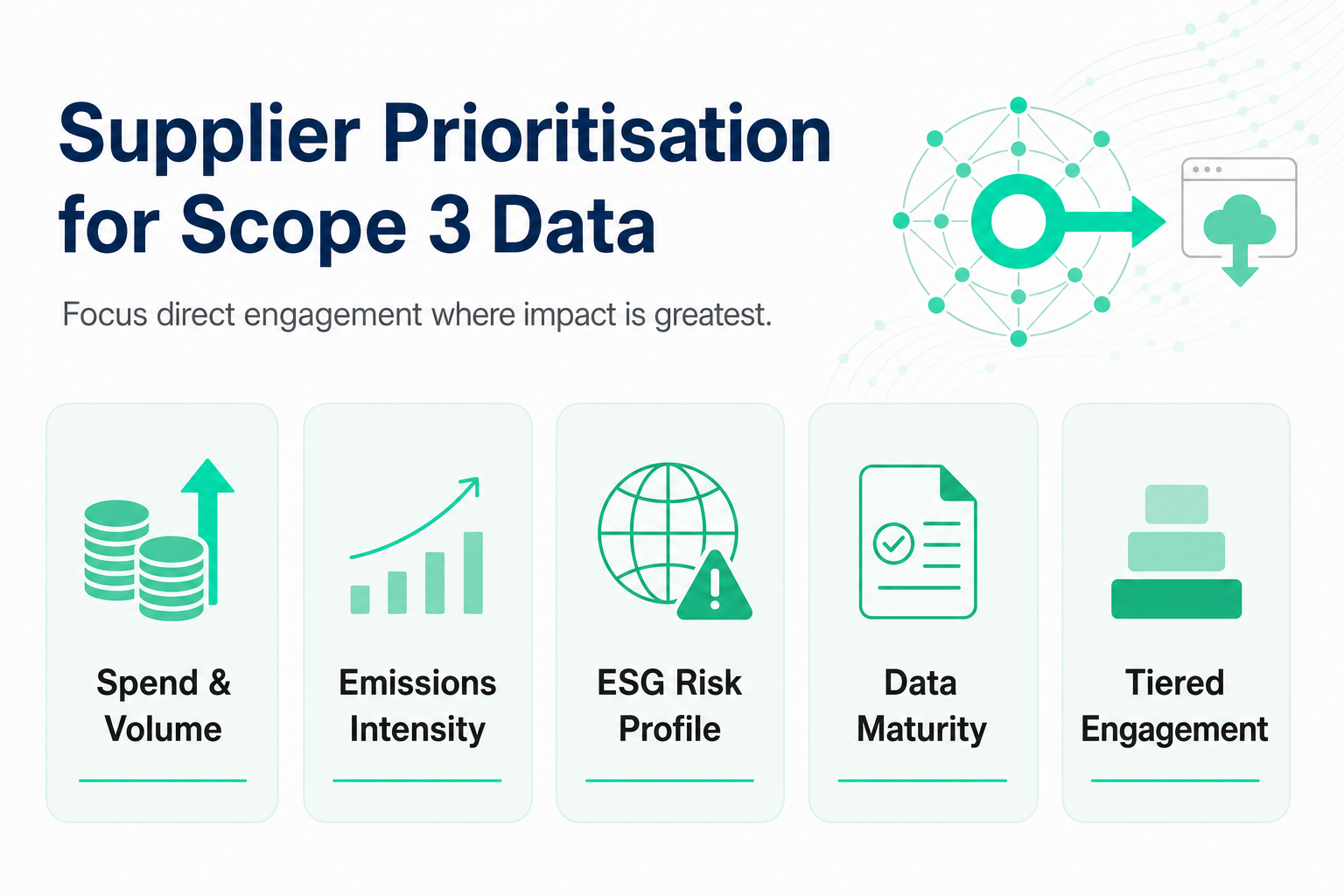
Prioritise suppliers by spend concentration, emissions contribution and data risk, not alphabetically or by contract renewal date. Start with the suppliers that represent the largest share of your Scope 3 footprint or procurement spend, then layer in factors such as sector emissions intensity, geography and existing data availability.
Most enterprise sustainability teams cannot collect verified ESG data from every supplier at once, so a tiered approach determines which suppliers get direct engagement, which get sector averages, and which get deferred.
Summary
- Prioritise suppliers using a combination of spend concentration, emissions intensity, ESG risk and data availability.
- Use a tiered model to concentrates direct engagement on the highest-impact suppliers while applying a proportionate approach to the rest.
- Prioritisation determines where to improve data quality; it does not mean excluding lower-priority suppliers from the Scope 3 inventory.
- Embed supplier tiering into existing procurement and supplier-management processes rather than running a separate exercise.
Why Does Supplier Prioritisation Matter for ESG Data Collection?
Scope 3 data collection at full scale is rarely achievable in one cycle for most organisations. Supplier data gaps, inconsistent measurement practices and multi-tier supply chain complexity mean that most enterprises cannot collect verified ESG data from all suppliers simultaneously.
Without a prioritisation method, sustainability teams risk spending limited engagement capacity on suppliers that contribute relatively little to the overall footprint, while the suppliers that matter most receive insufficient attention.
Reporting requirements and customer expectations can also influence how quickly better supplier data is needed. For Singapore-specific Scope 3 reporting timelines, see Scope 3 Reporting Requirements in Singapore.
What Criteria Should Determine Supplier Priority?
Supplier prioritisation should consider several factors rather than relying on a single measure such as spend. A practical approach combines financial weight, emissions exposure, ESG risk and the feasibility of obtaining better data.
1. Spend and Volume Concentration
Suppliers representing a disproportionate share of procurement spend typically also represent a disproportionate share of purchased goods and services emissions, which sit within Scope 3 Category 1 under the GHG Protocol.
Ranking suppliers by annual spend is usually the fastest starting filter, particularly when more granular emissions data is not yet available.
Category 1 is also where the CDP sector analysis puts a significant share of upstream emissions for most manufacturing and retail businesses, which is why it is the usual starting point for a first collection cycle.
However, spend should not be the only criterion. A supplier with relatively low spend may still have a significant emissions impact if it operates in a carbon-intensive sector.
Scope 3 Allocation Module
Deciding which suppliers to engage first?
Gprnt is building a new module to help companies manage, allocate and track supply chain emissions data with greater ease and clarity. Register your interest and our team will share more details.
Register your interest2. Coverage the Target Actually Requires
If the company has a science-based target, its Scope 3 coverage requirements can help determine whether the priority supplier group is sufficiently representative.
The SBTi criteria require Scope 3 to be included in near-term targets once it accounts for 40% or more of combined Scope 1, 2 and 3 emissions, and those targets must collectively cover at least 67% of Scope 3 emissions.
That coverage threshold can provide one reference point when determining how far supplier engagement needs to extend.
3. Emissions Intensity by Sector
Some sectors are inherently more carbon intensive than others regardless of spend.
A supplier in steel, cement or logistics is likely to contribute more emissions per dollar spent than a supplier of office software. Weighting suppliers by sector emissions intensity alongside spend prevents low-volume, high-intensity suppliers being overlooked.
4. ESG Risk Exposure
Supplier prioritisation may also take into account broader ESG risks such as labour practices, governance and geography.
Where relevant to the organisation's objectives, suppliers operating in higher-risk sectors or jurisdictions may warrant closer engagement even if they are not among the largest contributors by spend.
5. Data Availability and Feasibility
Some suppliers already report to CDP, hold an EcoVadis rating, or publish CSRD-aligned disclosures under the European Sustainability Reporting Standards (ESRS).
Where usable information already exists, the task may be to review and validate that data rather than start collection from scratch. Existing data availability therefore affects both the effort required and the order in which suppliers can realistically be engaged.
For more on what data to request from suppliers and how to structure the collection process, see How to Collect Scope 3 Data From Suppliers.
What Does a Tiered Supplier Prioritisation Model Look Like?
A tiered approach allows companies to match the level of engagement to the importance of the supplier.
The framework below is a general model rather than an official standard published by the GHG Protocol, PCAF or another named body. It should be adapted to the organisation's own footprint, risk profile and resources.
| Tier | Typical Profile | Engagement Approach |
|---|---|---|
| Tier 1 - High priority | High spend concentration, high sector emissions intensity, or elevated ESG risk | Direct engagement, primary data requests, ongoing monitoring |
| Tier 2 - Moderate priority | Mid-range spend or moderate sector intensity, some existing disclosure | Periodic data requests, verification of existing ratings or reports |
| Tier 3 - Lower priority | Low spend, low sector intensity, limited ESG risk indicators | Sector-average emission factors, light-touch review on a longer cycle |
Don't ask every supplier for the same level of data. Focus deeper engagement on the suppliers that matter most, while making the level of data requested proportionate to materiality, supplier readiness and how the information will be used.
Prioritising a supplier does not mean excluding the rest. Tiering determines where better data and deeper engagement matter most. Lower-priority suppliers can still remain within the Scope 3 inventory using appropriate estimates or secondary data..
This distinction is important because supplier prioritisation and Scope 3 boundary-setting are not the same thing. A company may use estimates for lower-priority suppliers without leaving their emissions out of the inventory altogether.
For more on when estimates versus supplier-specific information are appropriate, see [Spend-Based vs Supplier-Specific Scope 3 Data: What's the Difference?].
How Should a Sustainable Procurement Strategy Incorporate Supplier Tiering?
Supplier prioritisation becomes more useful when it is integrated into existing procurement and supplier-management processes rather than run as a separate sustainability exercise.
Aligning procurement's existing supplier segmentation with the sustainability team's Scope 3 priority list avoids duplicated outreach and conflicting requests to the same suppliers.
Practical Integration Steps
- Share the Scope 3 priority tiers with procurement before contract renewal or supplier review cycles begin.
- Reflect relevant sustainability-data requirements in supplier onboarding and re-tendering, with expectations proportionate to supplier priority.
- Use existing procurement relationship owners for priority suppliers, rather than creating a completely separate sustainability outreach channel.
- Review supplier tiers regularly as spend, emissions exposure and supplier data maturity change.
The objective is not to turn every procurement interaction into a reporting exercise. It is to make supplier data collection part of the existing relationship wherever possible.
Supplier data collection works better when it follows the relationship. Sustainability teams may define what data is needed, but procurement often owns the supplier relationship. Aligning the two reduces duplicate requests and makes engagement easier to sustain.
Want to get a headstart in your Scope 3 reporting?
Book a DemoHow Often Should Supplier Priorities Be Reviewed?
Supplier prioritisation should not be treated as a one-time exercise.
Spend allocation can change, suppliers can improve their emissions performance or reporting capabilities, and new high-impact suppliers can enter the value chain. A supplier that belongs in Tier 2 today may therefore move into Tier 1 in a future reporting cycle.
At minimum, supplier priorities should be reviewed alongside the organisation's regular Scope 3 reporting and procurement planning cycles.
an concentrating it on Tier 1 suppliers, leaves little capacity for verification or follow-up.
Frequently Asked Questions
How many suppliers should be in Tier 1?
There is no fixed number set by any standard body. The appropriate size will depend on the concentration of the company's emissions and procurement spend.
Rather than selecting an arbitrary number of suppliers, Tier 1 should capture the suppliers where direct engagement and better-quality data are likely to make the greatest difference.
Can sector-average emission factors be used for lower-tier suppliers?
Yes. Scope 3 inventories can combine different levels of data quality across the supplier base. Industry-average or other appropriate secondary data may be used for lower-priority suppliers while primary data collection is concentrated on higher-impact areas.
For a deeper comparison of these approaches, see [Spend-Based vs Supplier-Specific Scope 3 Data: What's the Difference?].
Should supplier prioritisation be revisited annually?
Yes. Spend allocation, supplier mix and disclosure maturity can change over time and may shift which suppliers carry the greatest emissions or ESG exposure.
Does supplier size affect prioritisation?
Supplier size alone is not a reliable indicator. A smaller supplier in a carbon-intensive sector may contribute more to Scope 3 emissions than a much larger supplier operating in a relatively low-intensity sector.
Supplier size should therefore be considered alongside factors such as spend, emissions intensity and risk rather than used as the primary filter.
How to Start
Start by identifying the suppliers that account for the largest share of your procurement spend or estimated emissions. Then layer in sector emissions intensity, risk and existing data availability to determine where deeper engagement is most worthwhile.
Once you have identified the suppliers to prioritise, the next challenge is collecting the right information from them consistently.
Next: How to Collect Scope 3 Data From Suppliers ->
Gprnt helps enterprises structure supplier sustainability data so it can be collected once and reused, with permission, across relevant reporting, procurement and financing use cases. It complements existing calculation and reporting processes rather than replacing them.
References
- GHG Protocol Corporate Value Chain (Scope 3) Accounting and Reporting Standard (2011)
- CDP, Technical Note: Relevance of Scope 3 Categories by Sector (2022)
- SBTi, Criteria and Recommendations for Near-Term Targets
- ACRA and SGX RegCo, Extended Timelines for Most Climate Reporting Requirements (August 2025)