Interoperable ESG data means the figures are captured once, in a common structure, and read by everyone who needs them without re-entry. That is a property of the infrastructure underneath reporting, not a feature of any single reporting tool.
Summary
- Suppliers are asked for the same data repeatedly because each buyer and lender collects it in its own container, not because the underlying data differs.
- EFRAG measured the overlap directly: across 12 real ESG questionnaires, energy and greenhouse gas emissions were requested in all 12.
- Interoperability requires common metrics, shared definitions, machine-readable exchange and permissioned access. An export button is not enough.
- The ISSB positions IFRS S1 and S2 as a global baseline for investor-focused disclosure, explicitly without preventing jurisdictions from requiring more.
- EU law now gives smaller suppliers a right to decline requests that go beyond the voluntary standard.
Why Does One Supplier Get Asked for the Same ESG Data Multiple Times?
A supplier's emissions data does not change depending on who is asking. What changes is the container it has to fit into. A bank's green loan questionnaire, a customer's Scope 3 supplier survey and an exchange's disclosure template each define fields, units and boundaries slightly differently, even when describing the same activity: fuel burned, electricity drawn, waste generated.
The scale of that duplication has been measured rather than estimated. EFRAG's secretariat analysed 12 real ESG questionnaires, issued by national central banks, national federations, banks, a rating agency and mixed bank and supply chain initiatives.
Those questionnaires cover around 26,000 SMEs and sit within initiatives comprising roughly 700 banks and 450 value chain companies. A separate rating agency questionnaire in the sample is used by more than 100,000 companies efrag.org.
The overlap across those 12 questionnaires is the clearest evidence of the problem:
Read this carefully, because it is a claim about questionnaire design rather than about how many forms any one supplier fills in. EFRAG found that in 2023 most SMEs received only one request a year, in a simple format, at limited cost. The duplication is in the instruments: twelve separate questionnaires, built separately, asking for the same underlying figures.
That is what makes the trajectory matter. As reporting obligations widen, the same overlapping questions reach the same suppliers through more channels, and the EU legislature has already recorded evidence that value chain companies including SMEs receive disproportionate requests for information eur-lex.europa.eu. Aligning the instruments now is cheaper than unpicking them later.
What Does ESG Interoperability Mean, Concretely?
Interoperability is the ability of different reporting systems and standards to exchange the same underlying data without loss of meaning. In practice it requires four things together.
What Role Do Global Baselines Play?
Software can move data between systems. Only a common standard makes the data mean the same thing when it arrives.
The GHG Protocol supplies the accounting rules for what counts as Scope 1, 2 and 3 emissions ghgprotocol.org. The ISSB issued IFRS S1 and S2 in June 2023, describing them as creating a global baseline, supported by the G20, that provides investors with globally comparable disclosures without constraining jurisdictions from requiring additional ones ifrs.org.
The qualifier is worth keeping: it is a floor for investor-focused disclosure, not a ceiling and not a single standard for all sustainability reporting.
Alignment work between the major frameworks is active. The IFRS Foundation and EFRAG jointly published interoperability guidance in May 2024, mapping ISSB Standards and ESRS to reduce complexity, fragmentation and duplication.
It covers general requirements including materiality, then climate in paragraph-level detail. The document is explicit that it is educational material, does not override either set of requirements, and is not a formal statement of equivalence ifrs.org.
For smaller companies, work has gone into a lighter starting point. Project Savannah, a collaboration between UNDP, GLEIF and MAS announced in June 2023, aims to simplify ESG reporting for MSMEs by generating basic ESG data credentials that can be held in a company's Legal Entity Identifier record and transmitted to business partners gleif.org.
Its 2024 white paper proposes a baseline metrics set and is careful about its own status: Project Savannah does not introduce a divergent standard for MSMEs, it articulates a starting point.
How Does One Emissions Record Reach Multiple Destinations?
The clearest way to see interoperability working is to follow a single data point: one supplier's diesel consumption for a delivery fleet in one quarter.
- Capture. The supplier logs fuel volume once, manually or through an integration with an accounting or fuel-card system.
- Calculation. A recognised emission factor converts litres into tonnes of CO2 equivalent, rather than a different factor per recipient.
- Structuring. The figure is tagged against a common metric definition aligned with the GHG Protocol.
- Permissioning. The supplier sets access rules per recipient.
- Exchange. Each recipient reads the same structured record through its own workflow.
The supplier calculated once. Each destination reads the same record through a different lens.
Does Sharing Mean Losing Control?
Interoperability without access control would mean every recipient sees everything, which suppliers reasonably resist. Role-based permissions attach visibility rules to the data itself.
- A bank can be granted aggregate emissions trends without per-customer allocation.
- A specific customer can be granted only the emissions share attributable to goods supplied to them.
- Corrections can be tracked and re-permissioned without reissuing the record to every party.
Reusable does not mean public. The data model carries the permission logic.
What Would Make Report Once the Default?
Bilateral integrations between two companies do not scale. A shared layer needs someone to designate and operate it, and increasingly regulators are pushing in that direction rather than waiting for the market.
The European Commission's 2025 recommendation on voluntary SME reporting names the trickle-down effect, where companies subject to reporting requirements pass information requests to value chain companies that are not, and sets out to reduce the need for SMEs to answer separate requests from individual counterparties eur-lex.europa.eu.
Directive (EU) 2026/470 turns that into a right: companies averaging 1,000 employees or fewer in a reporting company's value chain may decline to provide information exceeding the voluntary standard eur-lex.europa.eu.
Singapore has approached the same problem through shared national infrastructure rather than a cap on requests. Both routes point the same way: a supplier should produce the data once, and the burden of translation should sit with the systems, not the supplier.
Frequently Asked Questions
What is ESG data interoperability in simple terms?
It is the ability to capture sustainability data once and have every system or organisation that needs it read it correctly, without manual re-entry or reformatting.
How do I automate sustainability reporting as a supplier?
Capture activity data such as fuel, electricity and waste through an integration rather than manual logs, apply a recognised emission factor, and structure the output against a standard such as the GHG Protocol so it can be reused across requests.
Do smaller suppliers need to follow the same standards as large enterprises?
Not identically. Lighter starting points exist, including the baseline metrics set proposed under Project Savannah and the EU's voluntary standard for SMEs, both aligned with the logic used in larger frameworks.
Why can't every buyer just accept a PDF report?
A PDF is not machine-readable, so each recipient re-enters the figures into its own system. Interoperability requires structured data, not a shared document format.
About Gprnt
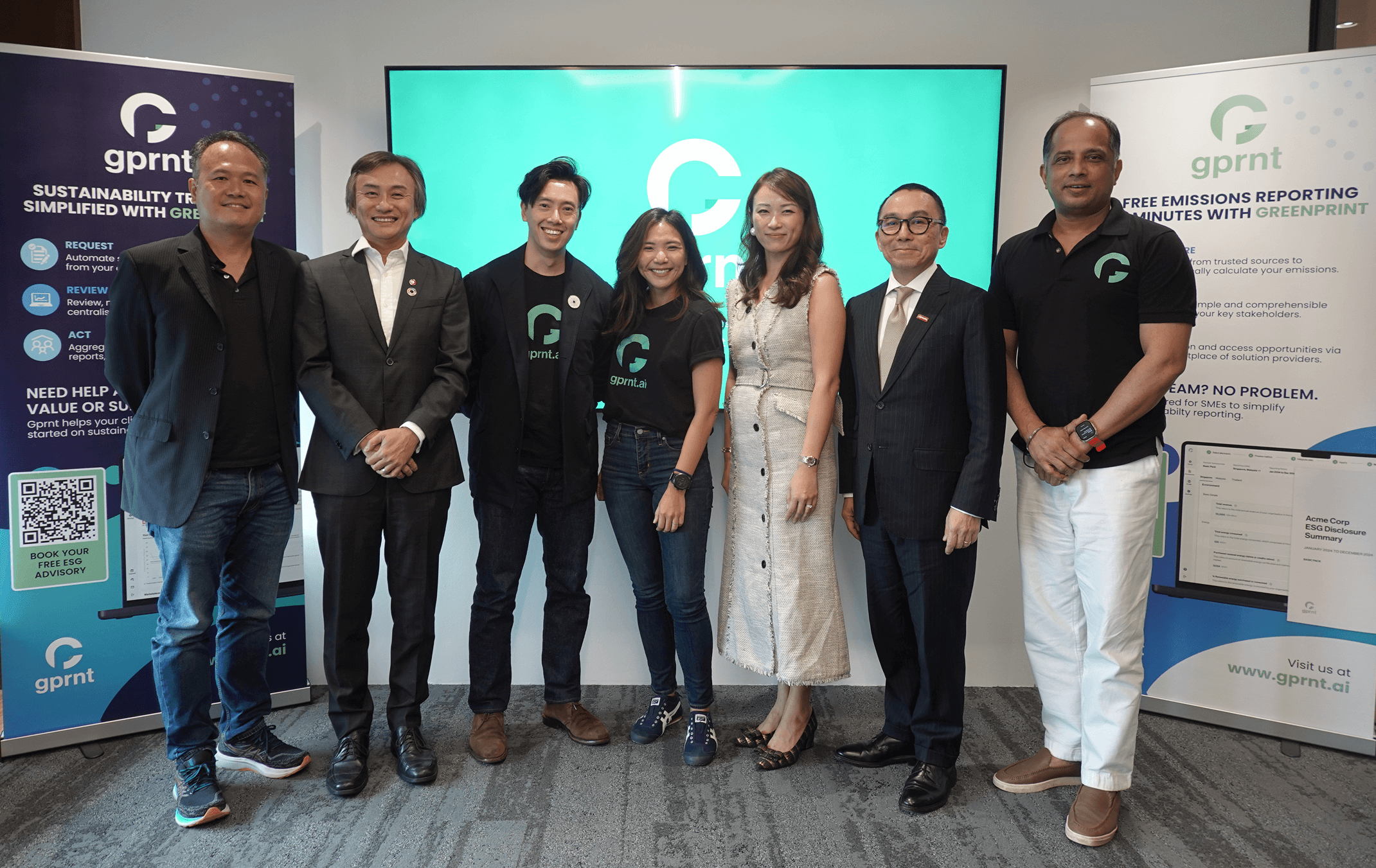
Gprnt is the digital sustainability infrastructure behind Singapore's national reporting ecosystem, launched by the Monetary Authority of Singapore and operated by the Global Finance & Technology Network. It connects SMEs, enterprises, banks and governments through one interoperable data layer covering Disclosure, Value Chain Intelligence, Sovereign ESG Infrastructure and Ecosystem.
Entry-level Scope 1 and 2 reporting is free for SMEs, and reports are audit-friendly and aligned with the GHG Protocol and ISSB standards. The design goal is that a supplier's data, once captured, connects across procurement, financing and regulatory disclosure without re-collection.
If your organisation is answering the same sustainability data request from multiple buyers and banks, visit gprnt.ai.
References
- EFRAG, VSME Exposure Draft Basis for Conclusions (January 2024), BC44 and BC45 (efrag.org)
- IFRS Foundation and EFRAG, ESRS-ISSB Standards Interoperability Guidance (May 2024) (ifrs.org)
- IFRS Foundation, ISSB issues inaugural global sustainability disclosure standards (June 2023) (ifrs.org)
- GHG Protocol, Corporate Value Chain (Scope 3) Accounting and Reporting Standard (ghgprotocol.org)
- GLEIF, UNDP and MAS, Project Savannah announcement (June 2023) (gleif.org)
- Commission Recommendation (EU) 2025/1710 on a voluntary sustainability reporting standard for SMEs (eur-lex.europa.eu)
- Directive (EU) 2026/470 (eur-lex.europa.eu)